RunSQL vs. DB Fiddle: A Comprehensive Comparison of SQL Playgrounds
1. Introduction
SQL playgrounds have become essential tools for developers, data analysts, and database administrators. They allow users to test queries, validate schema designs, and debug issues without setting up a full database locally.
Among the many SQL playgrounds available, RunSQL and DB Fiddle are two of the most widely used options. However, based on developer feedback, each has its strengths and weaknesses.
This article explores the common pain points of SQL playgrounds, how RunSQL and DB Fiddle compare, and which one might be the better choice for your needs.

2. Common Pain Points in SQL Playgrounds
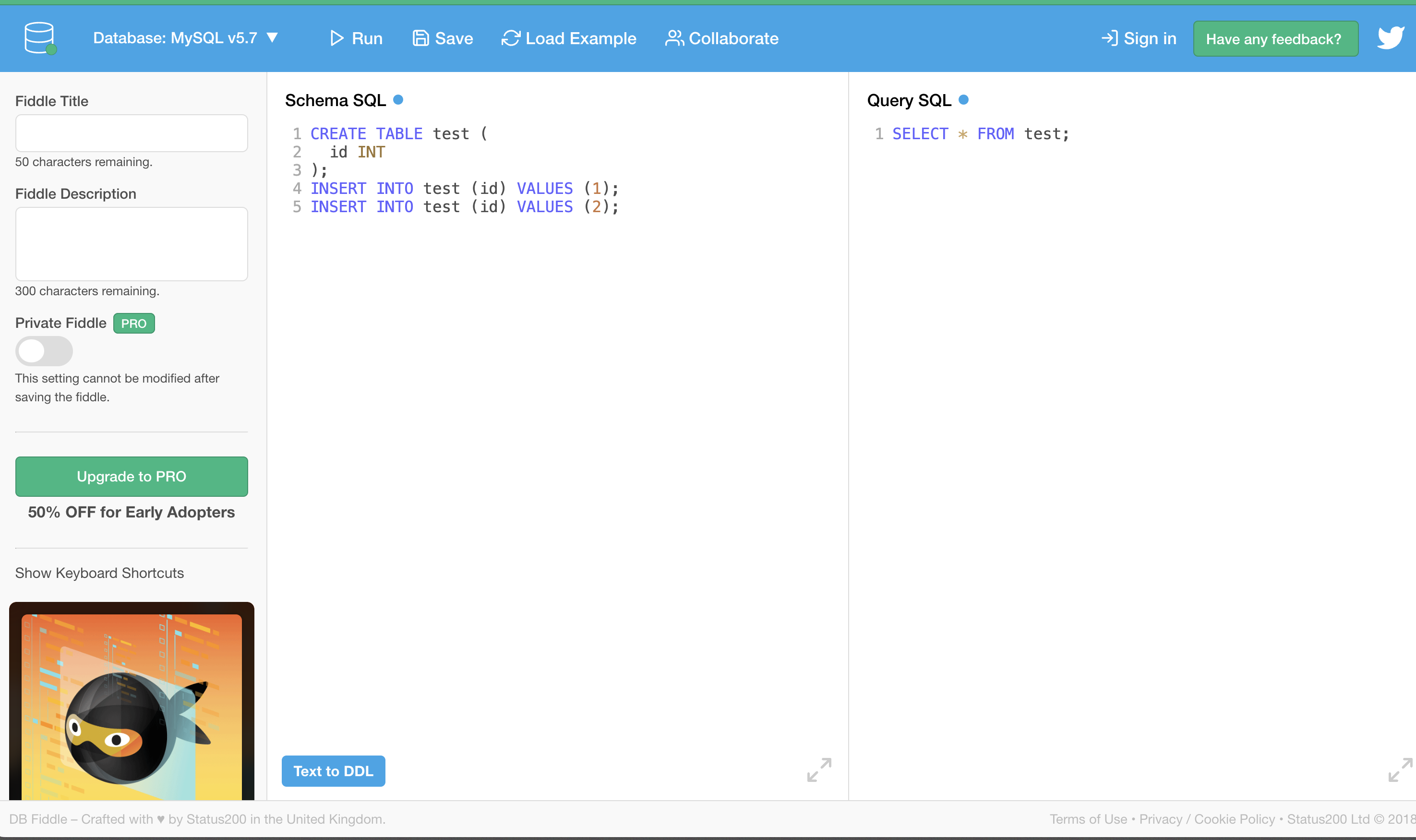
Developers on Reddit and other online communities frequently share their frustrations with SQL playgrounds. Based on real-world feedback, here are the biggest issues they face:
2.1 Limited Database Support
Many SQL playgrounds only support a handful of databases, making it difficult for developers working with less common SQL dialects to test their queries.
- DB Fiddle supports: PostgreSQL, MySQL, and SQLite.
- RunSQL supports PostgreSQL, MySQL, and SQL Server.
2.2 Performance Issues with Query Execution
Developers often complain about slow execution times, especially when running complex queries or handling larger datasets.
- DB Fiddle users report inconsistent execution times, particularly with joins and subqueries.
- RunSQL uses cloud-based sandboxes, ensuring faster and more reliable query execution.
2.3 Manual Schema and Data Setup
Setting up tables and inserting data manually can be tedious and time-consuming.
- DB Fiddle requires users to manually write
CREATE TABLEandINSERT INTOstatements. - RunSQL simplifies schema creation using DBML and lets users populate test data through an Excel-like UI or CSV uploads.
2.4 Lack of Advanced Features
Many SQL playgrounds are limited to basic query execution and lack features like schema visualization, AI-powered test data, or structured collaboration tools.
- RunSQL is introducing AI-generated test data and advanced schema management tools.
- DB Fiddle remains a minimalist tool, focusing on basic SQL testing.
2.5 Limited Collaboration & Sharing Options
Sharing SQL queries with teammates is essential, but many playgrounds only allow users to share raw query links without preserving the test database or data setup.
- DB Fiddle allows query sharing but doesn’t save test datasets.
- RunSQL lets users share fully configured SQL environments, including schemas and test data.
3. RunSQL vs. DB Fiddle: Feature Comparison
| Feature | RunSQL | DB Fiddle |
|---|---|---|
| Schema Definition | DBML-powered (no manual SQL needed) | Requires manual CREATE TABLE |
| Data Population | UI-based, CSV upload, AI-generated test data (coming soon) | Manual INSERT statements |
| Query Execution | Cloud-based, faster execution | Browser-based, sometimes slow |
| Collaboration | Share schema + data + queries | Only shares queries |
| Database Support | PostgreSQL, MySQL, SQL Server | PostgreSQL, MySQL, SQLite |
| Ease of Use | Beginner-friendly | Requires manual SQL |
4. Use Cases: Which Tool is Right for You?
4.1 Best Use Cases for RunSQL
✅ Developers writing complex queries on structured datasets.
✅ Teams debugging SQL queries together.
✅ Interviewers testing SQL skills in a shared environment.
4.2 Best Use Cases for DB Fiddle
✅ Quick SQL syntax validation.
✅ Users working with multiple database dialects.
5. Collaboration & Sharing
Collaboration is crucial in modern SQL development. Whether debugging queries, conducting an SQL interview, or sharing test cases with a team, a good SQL playground should make collaboration seamless.
| Feature | RunSQL | DB Fiddle |
|---|---|---|
| Share SQL + Data | ✅ Yes | ❌ No |
| Direct Execution of Shared Queries | ✅ Yes | ❌ No |
| Team-Friendly Debugging | ✅ Yes | ❌ No |
With RunSQL, teammates can open shared SQL workspaces and execute queries immediately. In contrast, DB Fiddle only shares queries, requiring recipients to manually recreate schemas and insert test data.
6. Performance & User Experience
- RunSQL provides a faster query execution environment thanks to cloud-based sandboxes.
- DB Fiddle users report inconsistent execution times, particularly with joins, subqueries, and large datasets.
For developers testing complex queries, RunSQL offers a more stable experience.
7. Database Support & Future Expansion
| Feature | RunSQL | DB Fiddle |
|---|---|---|
| Supports PostgreSQL? | ✅ Yes | ✅ Yes |
| Supports MySQL? | ✅ Yes | ✅ Yes |
| Supports SQL Server? | ✅ Yes | ❌ No |
| Supports SQLite? | ❌ No | ✅ Yes |
DB Fiddle currently supports more database types, but RunSQL offers support for major enterprise databases while focusing on workflow improvements.
8. Conclusion
| Feature | RunSQL ✅ | DB Fiddle ❌ |
|---|---|---|
| Beginner-friendly | ✅ Yes | ❌ No |
| Fast schema setup | ✅ Yes | ❌ No |
| Easy data population | ✅ Yes | ❌ No |
| Collaboration tools | ✅ Yes | ❌ No |
Final Verdict: Which SQL Playground is Better?
- For structured SQL development, debugging, and collaboration → RunSQL is the better choice.
- For quick syntax validation across multiple databases → DB Fiddle is useful.
🚀 Try RunSQL
9. FAQs
9.1 Is RunSQL better than DB Fiddle for beginners?
Yes, RunSQL is easier to use because it removes the need for manual schema and data setup.
9.2 Can I use RunSQL for free?
Yes! RunSQL’s free version includes schema design, query execution, and sharing features.
9.3 Does RunSQL support MySQL and SQL Server?
Yes, RunSQL now supports PostgreSQL, MySQL, and SQL Server.
9.4 Which tool is better for team collaboration?
RunSQL. It allows sharing entire SQL workspaces, while DB Fiddle only shares individual queries.